NVIDIA RTX Spark desktops: local AI on Windows
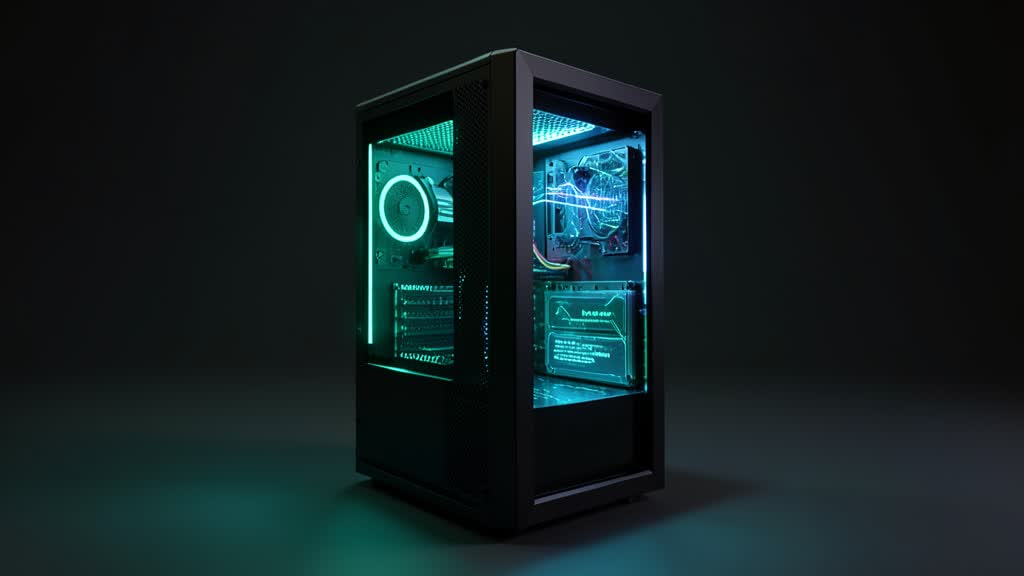
On November 18, 2026 NVIDIA said RTX Spark compact desktops from ASUS, Dell and MSI are available to buy, with more from Acer, GIGABYTE, HP and Microsoft to follow. The systems pair a 20-core Grace CPU and a 6,144-core Blackwell RTX GPU with up to 128GB of unified memory - enough headroom for 120-billion-parameter models locally and for agents that keep running while a laptop is closed.
- Up to 128GB of unified memory — NVIDIA says the RTX Spark desktops carry up to 128GB of unified memory shared between CPU and GPU, with a 20-core Grace CPU, a Blackwell RTX GPU with 6,144 CUDA cores and up to 1 petaflop of FP4 AI performance.
- 120-billion-parameter models locally — The headline capability NVIDIA lists is running massive 120-billion-parameter large language models locally, alongside real-time rendering of 90GB+ 3D scenes and real-time 4:2:2 video editing.
- A desktop that stays on — NVIDIA frames the compact desktop as a machine for local models and always-on agents - one that keeps agents and scheduled tasks running while a laptop travels or handles other work.
- Third-party mini PCs and a Surface variant — ASUS, Dell and MSI systems are on sale now. Acer, GIGABYTE and HP mini PCs are described as coming soon, along with the Microsoft Surface RTX Spark Dev Box.
The hardware that makes local models practical
Related guide: Nemotron 3.5 Bolt: NVIDIA's 74B and 4GB open models bring agents to local hardware
The architecture is the reason these machines exist. NVIDIA says each RTX Spark desktop is equipped with a 20-core Grace CPU, an NVIDIA Blackwell RTX GPU with 6,144 CUDA cores, and up to 128GB of unified memory, delivering up to 1 petaflop of AI performance in FP4. Unified memory is the crucial part: because CPU and GPU share the same memory pool, a model does not have to fit in VRAM alone, which removes the classic reason a 70-billion or 120-billion-parameter model would not load on a consumer card.
NVIDIA lists the practical consequences directly: running 120-billion-parameter large language models locally, rendering 90GB-plus 3D scenes in real time, and smoothly editing 4:2:2 video in real time. Connectivity is 10-gigabit Ethernet, aimed at moving large datasets and model files to and from networked storage rather than over a laptop dock.
The honest caveat is that these are vendor specifications. There is no independent benchmark in NVIDIA's announcement comparing real inference throughput or tokens per second against a cloud GPU, so the practical test is still yours to run: load the model you actually use, at the quantisation you actually use, and measure. The memory ceiling is what is clearly documented; the speed is not.
Why a desktop instead of a laptop
Related guide: Vera Rubin's MLPerf debut: 2x training, 10x agent efficiency
NVIDIA's argument for the compact desktop is uptime and workload separation. A dedicated machine can keep agents and scheduled tasks running while a laptop travels or handles other work - the same always-on pattern that pushed our automation and scheduling guides toward machines that stay powered rather than sessions that end when a screen locks.
There is a second reason, and it is economic. NVIDIA's post states that running supported models locally keeps code and files processed on the PC and avoids per-token cloud API charges for those tasks. For a workload that runs a small local model continuously - a coding agent on a repository, a local transcription job, a private RAG over internal documents - the trade is straightforward: a one-time hardware purchase against a recurring inference bill, plus the fact that the data never leaves the machine.
Neither point argues that cloud is obsolete. Frontier reasoning still happens in hosted models. The claim is narrower and more useful: a dedicated local box can absorb the high-volume, latency-tolerant, privacy-sensitive tail of an AI workload while a frontier model handles the hard calls. That is the same split our infrastructure guides keep arriving at, and it is now available as a single box rather than a rack of cards.
The software story: CUDA, Arm and agent frameworks
Related guide: Microsoft Execution Containers: Agent Security, Explained
NVIDIA is careful to point out that this is not only a hardware launch. Native CUDA support and Linux development tools through the Windows Subsystem for Linux give developers a base for local workflows, and the announcement specifically names Hermes Agent and NVIDIA NeMoClaw blueprints as ways to set up agents, with Unsloth for fine-tuning supported models.
The routing piece may matter more than any single integration. NVIDIA says Switchyard, available in Hermes, automatically routes agent tasks between local and cloud models - everyday work stays on the device while harder reasoning goes to a hosted frontier model. That is the architecture this hardware is designed for: not a local-only machine, but one where the local model is the cheap default and the cloud model is the escalation path.
Creative pipelines get the same treatment. NVIDIA describes workflows that connect Photoshop and ComfyUI through Hermes Agent, so a sketch can become a rendered image or an animation through natural-language instructions, with RTX Video Frame Generation and RTX Video HDR extending a generated clip to 60 frames per second and high dynamic range inside a single ComfyUI workflow. Adobe applications are getting native Windows on Arm support, with NVIDIA citing up to 30% higher performance for Illustrator over its emulated version and 50% quicker turnaround on everyday H.264 deliverables in Premiere.
What this is not
Related guide: Nvidia Q3 FY27 earnings preview: $108B guide, new CEO
It is worth being clear about the boundaries, because the marketing language around local AI compresses several different things together. RTX Spark desktops are not a substitute for a data-centre GPU cluster: 128GB of unified memory is enormous for a desktop and small for training a frontier model. They are also not a turnkey local-LLM appliance - the announcement describes development workflows and named tool integrations rather than a preloaded model stack, so setup work is still yours.
Windows on Arm compatibility is the other practical question. NVIDIA is explicit that Adobe applications are gaining native support, but the wider Windows ecosystem on Arm still varies by application, and the announcement's own framing - native CUDA, WSL for Linux tooling, native Windows on Arm for the creative stack - implies a mixed environment rather than a uniform one. If your pipeline depends on a specific Windows tool that has no Arm build, verify it before buying.
Whether it is worth buying now
Related guide: Mistral Large 4 open weights: Europe's 1T MoE is now downloadable
The case is strongest for a specific profile: someone with a real local workload, a real privacy requirement, or a real token bill, who can tolerate Windows on Arm and is comfortable wiring their own tools. For that person, an RTX Spark desktop turns "local model" from a hobby project with memory limits into a machine sized for serious use, and the November 18 availability from three vendors makes it purchasable rather than theoretical.
The case is weakest for someone who needs frontier-model quality for a specific task and would spend the difference on API access to a better model anyway, or for someone whose workflow already runs happily on a rented GPU for a few cents an hour. The comparison to make is not against a cloud GPU in the abstract; it is between total monthly cost at your actual hours of use, and the flexibility of not owning the hardware.
For the wider industry, the more interesting signal is that unified-memory Windows desktops are now a shipping product category with three vendors on sale and four more announced. If the memory ceiling stops being the binding constraint on local inference, the cloud-versus-local decision becomes a workload decision rather than a hardware-capability decision - which is a much healthier place for the ecosystem to be.
Frequently asked questions
Up to 128GB of unified memory
NVIDIA says the RTX Spark desktops carry up to 128GB of unified memory shared between CPU and GPU, with a 20-core Grace CPU, a Blackwell RTX GPU with 6,144 CUDA cores and up to 1 petaflop of FP4 AI performance.
120-billion-parameter models locally
The headline capability NVIDIA lists is running massive 120-billion-parameter large language models locally, alongside real-time rendering of 90GB+ 3D scenes and real-time 4:2:2 video editing.
A desktop that stays on
NVIDIA frames the compact desktop as a machine for local models and always-on agents - one that keeps agents and scheduled tasks running while a laptop travels or handles other work.
Third-party mini PCs and a Surface variant
ASUS, Dell and MSI systems are on sale now. Acer, GIGABYTE and HP mini PCs are described as coming soon, along with the Microsoft Surface RTX Spark Dev Box.
Prices and benchmark figures are standard published rates as of November 19, 2026 and can change without notice. Some outbound links may be affiliate links — see our disclosure. Found an error? Tell us and we'll correct it in public.